Same EBITDA, Different Price: Why Two $2 Million Companies Sell Millions Apart
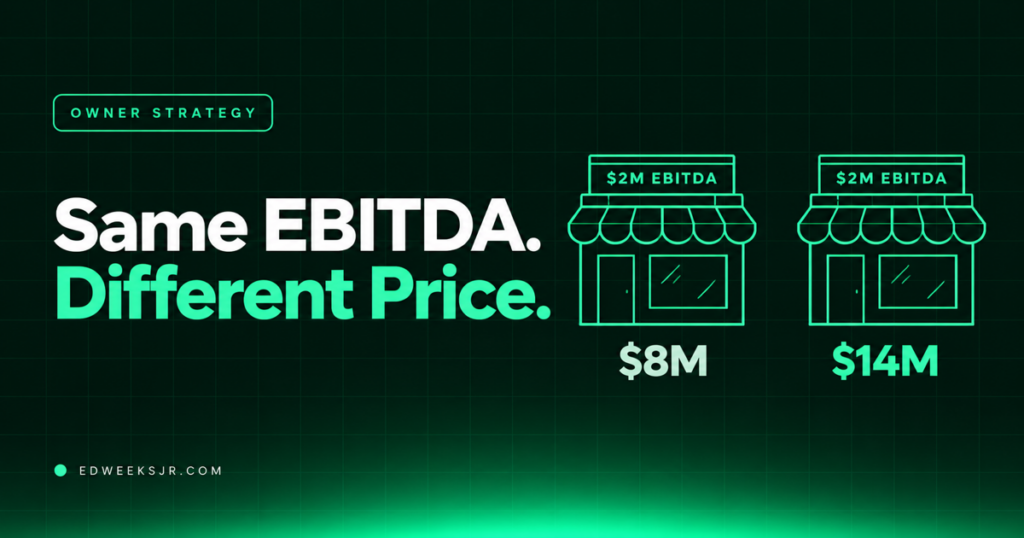
Picture two HVAC companies in neighboring towns. Both did about $2 million of EBITDA last year. The first sells for $8 million. The second sells for $14 million.
The example is illustrative, but gaps like that are common in private company sales. The difference between 4x and 7x rarely comes from the EBITDA number itself. It comes from how confident a buyer is that the earnings are real, will survive the owner’s departure, and can be verified quickly. A multiple is a price on that confidence.
This article covers what the market is paying right now, the five factors that most often separate the two companies, and the gap between the headline price and the cash a seller receives at closing.
What is a $2 million EBITDA company worth right now?
There is no single answer, but current data gives a useful starting range. It also shows why the multiples in the headlines usually don’t apply to a company this size.
Headline multiples describe bigger companies. TagniFi’s PowerComps data for the second quarter of 2026 put the median U.S. middle-market multiple at 6.9x adjusted EBITDA, up from 6.5x for 2025. GF Data reported a headline average of 7.0x for private equity-sponsored deals in the quarter, down from 7.3x. GF Data noted that the decline came mostly from a shift in deal mix at the top of the market.
Size moves the multiple. TagniFi’s medians by enterprise value were:
| Enterprise value | Median multiple of adjusted EBITDA |
|---|---|
| $10M to $25M | 5.7x |
| $25M to $50M | 7.6x |
| $50M to $200M | 9.4x |
GF Data’s average for $10 million to $25 million deals was 6.2x. That is a different dataset and an average rather than a median, but it is the same general neighborhood. A company with $2 million of EBITDA typically falls in that smallest band.
Buyer type matters. For add-on acquisitions of companies with $2 million to $5 million of EBITDA, TagniFi found private equity buyers paid a median of 6.5x, compared with 6.0x for corporate strategic buyers. Its contributors attributed the gap to a scarcity of quality targets.
GF Data’s guidance to sellers is worth repeating: “Benchmark to your size range and your buyer type, not to the headline.”
Demand in the trades is unusually strong. PitchBook counted 76 private equity deals in HVAC in the first half of 2026, worth $3.8 billion, compared with 63 deals in all of 2025. Roofing and plumbing platforms have kept adding companies as well:
- Ridgeline Roofing & Restoration, backed by Bertram Capital, made its 8th acquisition in September.
- Royalty Roofing closed its 4th acquisition of 2026 in August.
- Grove Mountain’s Team First Home Services added Holloway Plumbing in Texas.
Terms were not disclosed in those deals.
Strong demand raises the ceiling. It doesn’t tell you where your own company lands.
The five things that separate the $8 million company from the $14 million company
1. Recurring revenue
Revenue that renews without a new sales effort is worth more than revenue that has to be won again. In HVAC and plumbing, that usually means maintenance agreements. In an agency, it’s retainers under contract. In manufacturing, it’s long-term supply or service agreements.
What buyers want to see is the count, the trend, and the renewal rate, reported monthly. An owner who can produce that report in a few minutes is signaling that the revenue is real and managed.
2. Owner dependency
If the owner is the top salesperson, the lead estimator, and the first call for every important customer, the buyer is acquiring a business whose most valuable asset plans to leave.
Buyers usually respond in one of two ways:
- They lower the multiple.
- They move part of the price into an earnout the owner has to stay and earn.
SRS Acquiom’s 2026 Deal Terms Study, covering more than 2,300 private-target deals, found earnouts in 24% of 2025 deals. The median earnout was worth 34% of the closing payment.
Reducing owner dependency takes time. It means delegating decisions with real authority, putting a second relationship on every key customer, and building a management layer that can run operations. Starting two or three years before any transaction is realistic. Starting six months before is usually too late.
3. Add-backs that hold up
Adjusted EBITDA starts with reported earnings and adds back expenses a buyer won’t carry forward. Examples are owner perks, one-time legal costs, and above-market owner compensation.
Buyers expect add-backs. What they test is the support for each one. A quality of earnings review will accept documented, clearly non-recurring adjustments and push back on the rest.
Every rejected add-back is multiplied. A $150,000 adjustment that doesn’t survive diligence, at a 7x multiple, removes more than $1 million of value. The cheapest time to document add-backs is now, with your own CPA, before a buyer’s accountant asks.
4. Concentration
Any single dependency is a risk a buyer will price:
- a customer that represents a large share of revenue
- a technician who holds the key accounts
- a supplier or general contractor who drives most of the work
The answer might be diversification, a long-term contract, or deeper relationships inside the account. Buyers mostly want evidence that the owner knows the risk and has addressed it.
5. Financial quality
Monthly closes, financial statements that reconcile to tax returns, and revenue and gross margin split by line of business all shorten diligence. Shorter diligence costs the buyer less and produces fewer surprises. Surprises discovered after a letter of intent are a common trigger for price reductions.
How much can one factor matter?
TagniFi’s first-quarter 2026 data offers a clean example. Among manufacturers valued between $10 million and $50 million, the median multiple depended on EBITDA margin:
| EBITDA margin | Median multiple |
|---|---|
| Above median (about 23.9%) | 7.2x |
| Below median (about 13.5%) | 6.3x |
That’s nearly a full turn from margin alone, within the same size range, before customers or management enter the picture.
Headline price vs cash at closing
There is a second gap that matters as much as the multiple: the difference between the announced price and the money that reaches the seller.
The IBBA and M&A Source Market Pulse for Q2 2026 found that lower middle market sellers received roughly 83% to 92% of deal value at closing. The rest typically sits in escrows, seller notes, earnouts, and post-closing adjustments.
Earnouts are the biggest variable. SRS Acquiom’s earnout summary states that across all deals with an earnout, “closer to one out of five dollars gets paid.” That figure draws on data that includes life sciences milestones, which are often hard to reach, so other industries may see different results. Either way, an earnout should be valued as conditional money. The key terms are:
- the metric
- who controls the inputs
- what happens if the buyer integrates or resells the business
- partial payment terms
- audit rights and dispute resolution
The working capital peg is the other quiet variable. Most letters of intent assume the business will be delivered with a “normal” level of working capital, and a shortfall at closing typically reduces the price dollar for dollar. For seasonal businesses such as HVAC, roofing, and landscaping, the months used to define normal can move a meaningful amount of money. Owners who calculate their own normal level from 24 months of balance sheets negotiate the peg from facts.
Two offers with the same headline can be very different offers once structure is priced in.
What to do this quarter
- Score your company on the five factors: recurring revenue, owner dependency, add-backs, concentration, and financial quality. Most owners are strong on two or three.
- Pick the weakest factor and work on it for two quarters. Document add-backs with your CPA, hand off the decisions only you make, or begin reporting recurring revenue and renewal rates monthly.
- Benchmark correctly: your size range, your industry, your most likely buyer type. Ignore the headline averages.
- Look at structure, not just price. Know what share of an offer is cash at close, and what has to happen for the rest to be paid.
- Decide with real numbers. A realistic valuation range is what lets you choose well among keeping, growing, financing, selling, or partnering.
None of these steps commits you to a sale. Each one makes the company easier to finance, easier to grow, and easier to step back from.
This article is general education, not legal, tax, or investment advice. The $8 million and $14 million companies are an illustrative example, not a valuation of any business.
Sources
- TagniFi PowerComps Q2 2026 Market Update, via Private Equity Professional (Aug 27, 2026): https://peprofessional.com/2026/08/private-equity-buyers-pay-up-for-small-add-ons-as-middle-market-multiples-climb-to-6-9x/
- GF Data Q2 2026 commentary: https://www.linkedin.com/posts/gfdata_acg-privateequity-pe-activity-7506424956235333632-1Q8H
- ACG on GF Data Q2 2026: https://www.acg.org/news-trends/news/gf-data-reports-show-steady-middle-market-deal-flow-amid-more-selective
- PitchBook, Q2 2026 Construction & Engineering coverage (Aug 31, 2026): https://pitchbook.com/news/articles/ai-data-center-boom-private-equity-deals-electrical-hvac
- Ridgeline Roofing acquires Advantage Roofing & Exteriors (Sep 23, 2026): https://www.prnewswire.com/news-releases/ridgeline-roofing-acquires-advantage-roofing–exteriors-302886890.html
- Royalty Roofing and Tingley Roofing (Aug 27, 2026): https://schryverco.com/insights/royalty-tingley/
- Team First Home Services and Holloway Plumbing (Sep 14, 2026): https://www.prnewswire.com/news-releases/team-first-home-services-expands-texas-presence-through-partnership-with-holloway-plumbing-302877818.html
- SRS Acquiom 2026 Deal Terms Study: https://www.srsacquiom.com/our-insights/deal-terms-study/
- SRS Acquiom earnout and milestone trends: https://www.srsacquiom.com/our-insights/ma-earnout-milestone-trends/
- IBBA and M&A Source Market Pulse Q2 2026: https://www.prnewswire.com/news-releases/the-market-pulse-survey-q2-2026-reports-the-latest-trends-in-business-sales-up-to-50m-302858664.html