Skip to content
  • About
  • Services
  • Contact
  • Blog
  • Podcast

Book Your Strategy Session

Fill in your details below to request a time on my calendar. I look forward to learning more about your business.

    Exit Planning, Business

    39 of 77 HVAC Deals Went to Private Equity. Here’s How They Price Your Shop.
    July 21, 2026 edweeks_jr No comments yet
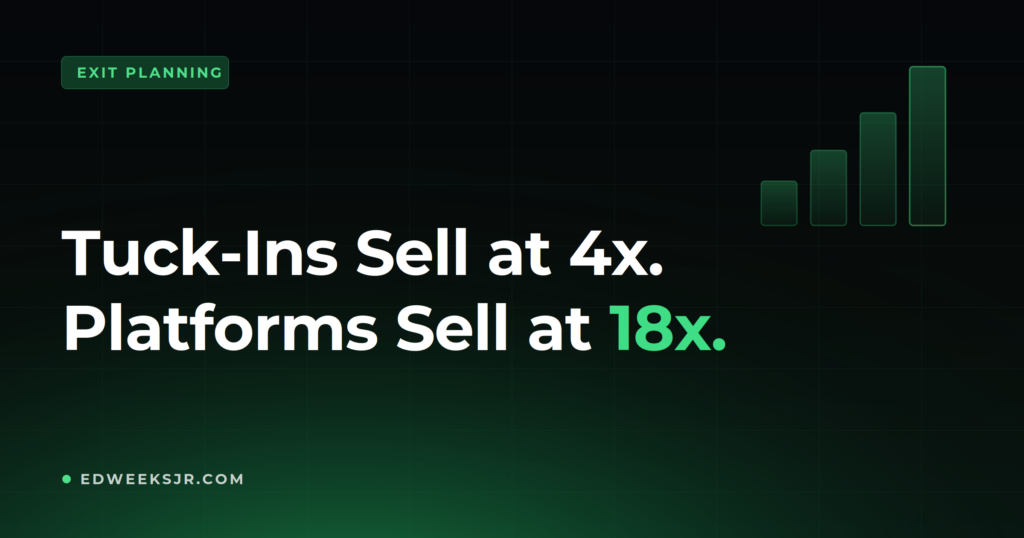
    HVAC M&A 2026: tuck-in shops sell at 4x EBITDA, platforms at 18x

    39 of 77 HVAC deals this year went to private equity

    HVAC M&A in 2026 is running hot, and here’s a number I can’t shake. Private equity took 39 of the last 77 HVAC deals tracked this year. More than half. The sector’s already at 149 transactions, up almost 13% over last year. If you own a heating and cooling, plumbing, or electrical business, this isn’t a trend you’re watching. It’s your buyer pool, and it’s moving right now.

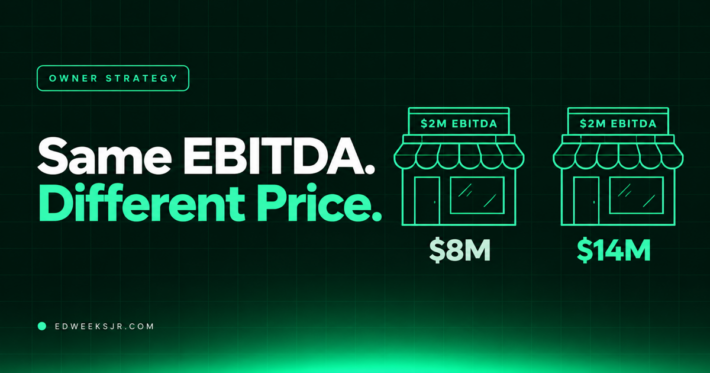
    And here’s the number that should stop you cold. When Blackstone bought the HVAC platform Champions Group this year, the price was around 18.5 times earnings. Roughly $2.5B on about $140M of profit. The offer that lands in a typical owner’s inbox? Four times. Maybe four and a half if the books are clean.

    Same trade. Same trucks. A wildly different number. Let me show you why, because you can fix your side of it, but not once a buyer’s already run the math.

    How the roll-up machine prices your business

    They anchor first. A PE firm buys one solid business, usually $3M or more in profit, at roughly 6x to 9x. That first buy becomes the platform. Everything else bolts onto it.

    Then they bolt on. They add smaller shops at 4x to 6x. These are the tuck-ins, and the volume’s enormous. With PE taking 39 of 77 deals this year, this is a factory running full shifts, not a rare event.

    Then they integrate. One back office, one brand, denser routes, better vendor pricing. Your profit, bought at 4x, now lives inside a bigger, cleaner machine a larger buyer will pay a premium for.

    Then they exit. The platform sells at 17x to 20x, usually inside 18 to 36 months. Goldman Sachs Alternatives just took a majority stake in Sila Services, a home-services platform running more than 30 brands. The spread between the 4x they paid the tuck-in and the 18x the platform commands was the prize all along.

    A common seller deal stack runs 50% to 70% cash at close, 10% to 15% earnout, and 15% to 30% rollover equity that lives or dies on the platform’s next exit. So part of your “price” is a bet on their machine, not a check in your pocket.

    Why owners never see it coming

    The tuck-in price isn’t a trick. It’s the floor. Most owners only ever see the floor, because they walk into the market without knowing where they sit on the ladder. A buyer knows exactly where you sit. You should too.

    There’s leverage hiding in these numbers, though. The platform can’t hit the scale that earns 18x without tuck-ins. They took more than half the deals this year because they’re hungry for exactly what you’ve got. Most sellers never price that in.

    Two plays to keep more of the spread

    Be the tuck-in they fight over. Density in one geography, recurring service revenue, and books a buyer can trust in a weekend move you from 4x toward 6x. On a business doing $2M in profit, that single turn is $4M more for the exact same company.

    Or become the platform yourself. Roll up two or three competitors within a 50 to 60 mile radius, and you’re the one getting bought high instead of sold low. Consolidation strands assets too. When a roll-up stalls, the websites, SEO, and customer lists go cheap, and you can be the one who grabs them.

    The owners who lose the most aren’t the ones with the weakest business. They’re the ones who never ran this math until a buyer ran it for them.

    So run it first. My free 20-minute Exit Readiness Scorecard grades you on exactly what a buyer grades you on. Take it before you take a meeting: Exit Readiness Scorecard.

    Not financial or legal advice. Multiples cited are public or reported ranges.

    • business valuation
    • HVAC
    • private equity
    • roll-up
    • selling a business
    edweeks_jr

    Post navigation

    Previous

    Leave a Reply Cancel reply

    Your email address will not be published. Required fields are marked *

    Search

    Categories

    • Business 3
    • Business Funding 6
    • Exit Planning 9
    • Guides 6
    • Insights 4

    Recent posts

    • HVAC M&A 2026: tuck-in shops sell at 4x EBITDA, platforms at 18x
      39 of 77 HVAC Deals Went to Private Equity. Here’s How They Price Your Shop.
    • Founder-led rollup: operator buyer alternative to selling to private equity
      We Hated Private Equity. So We Became the Buyer.
    • Owner-dependent business lowers valuation when selling a company
      Owner-Dependent Business? Why the Business Only You Can Run Is Worth Less Than You Think

    Tags

    business acquisition business exit business growth business owner business sale business valuation exit planning founder-led business HVAC M&A mergers and acquisitions MSP operator buyer owner dependency private equity roll-up rollup strategy selling a business small business succession planning transferable value

    Continue reading

    Founder-led rollup: operator buyer alternative to selling to private equity
    Exit Planning, Business, Business Funding

    We Hated Private Equity. So We Became the Buyer.

    July 10, 2026 edweeks_jr No comments yet

    I got on a call with a founder who turned his single biggest fear, selling to private equity, into his business model. He started a managed services provider (MSP) in 2010. Grew it to about 75 people and $12 million a year. He’s not a finance guy. He’s an operator who got tired of his […]

    Owner-dependent business lowers valuation when selling a company
    Exit Planning, Business

    Owner-Dependent Business? Why the Business Only You Can Run Is Worth Less Than You Think

    July 8, 2026 edweeks_jr No comments yet

    The Business Only You Can Run Is Worth Less Than You Think An owner-dependent business is one of the biggest reasons business owners leave money on the table when they sell. A few months ago I got on the phone with the owner of a residential HVAC company here in the Hudson Valley. Good business. […]

    Continue reading

    Founder-led rollup: operator buyer alternative to selling to private equity
    Exit Planning, Business, Business Funding

    We Hated Private Equity. So We Became the Buyer.

    July 10, 2026 edweeks_jr No comments yet

    I got on a call with a founder who turned his single biggest fear, selling to private equity, into his business model. He started a managed services provider (MSP) in 2010. Grew it to about 75 people and $12 million a year. He’s not a finance guy. He’s an operator who got tired of his […]

    Owner-dependent business lowers valuation when selling a company
    Exit Planning, Business

    Owner-Dependent Business? Why the Business Only You Can Run Is Worth Less Than You Think

    July 8, 2026 edweeks_jr No comments yet

    The Business Only You Can Run Is Worth Less Than You Think An owner-dependent business is one of the biggest reasons business owners leave money on the table when they sell. A few months ago I got on the phone with the owner of a residential HVAC company here in the Hudson Valley. Good business. […]

    Start. Build. Grow. Exit. On Your Terms.

    • Socials / Newsletters

    © Ed Weeks Jr. MBA | All Rights Reserved.

    • Privacy Policy

    Quick Links: Our Services  ·  Seller Financing Explained  ·  How to Sell a Business After 50  ·  How SBA Loans Work  ·  Contact